Adobe House Plans & Southwestern House Plans From

Architectural House Plans - home plans & house floor plans

Southwestern Style Homes and Plans & Southwest House Plans

Architectural House Plans

Adobe House Plans

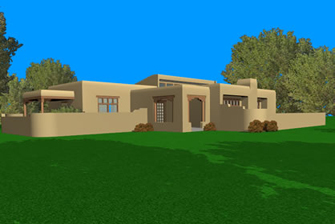
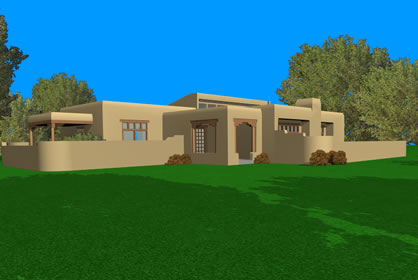
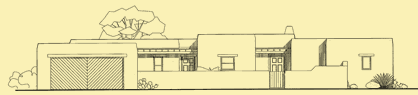
Our adobe house plans were designed by architects working in the Southwest, but they are popular in many other regions of the country. Our adobe-style floor plans are unique and distinctive, and the thick walls allow for unusual design elements inside the home.

Adobe Home Plans

Common Characteristics of Adobe-Style Home Plans:


Click on the button below to browse our adobe home plans!


Adobe Home Plans


What follows are excerpts from “American Shelter”, written by Lester Walker, and published by Overlook Press in 1997

Pueblo Revival (Adobe)

American Shelter by Lester Walker The Pueblo Revival Style takes its name from the prototypical adobe, flat-roofed pueblos built by the Hopi and Pueblo Indians in New Mexico and northern Arizona. It was introduced in California by Boston architect A.C. Schweinfurth with a hotel in Montalvo in 1894. Later, he designed a number of buildings, including the Hearst ranch in Pleasanton in the style. By 1915, in New Mexico and Arizona, the Pueblo Revival Style became popular for hotels, college campus buildings, churches, and other public buildings. It was seen as the marriage of an archeological and modern spirit.

The Pueblo Revival house, like the original pueblo dwelling, is characterized by massive looking battered walls with rounded corners. Roofs are always flat and usually have parapet walls. The most recognizable element of the style is the projecting rounded roof beam known as a “viga.” Second-and third-story levels are usually stepped and terraced to resemble the Indian habitats. When not built of adobe, Pueblo Revival  Style buildings try to look as though they were. Walls are always plastered when they are not adobe and are always given a heavy rounded look.

The style is also known as the Southwest Indian Revival, the Hopi, and Pueblo Indian Styles.


What follows are excerpts from “American House Styles: A Concise Guide”, written by John Milnes Baker, A.I.A., and published by W. W. Norton in 1994

Pueblo (Adobe) 1900-1990s

American House Styles: A Concise Guide by John Milnes Baker, A.I.A J.C. Schweinfurth’s Hacienda del Pozo de Verona in Pleasanton, California, designed for Phoebe Apperson Hearst in 1898 was the first major residential commission designed in the Pueblo style. The single most important indicator of the style is the projection of roof beams a foot or so out from the adobe wall. They are called vigas.

The prototype for the Pueblo style was the Governor’s Palace built in Santa Fe, New Mexico, in 1609. It was a blending of the local Indian building techniques with Spanish planning and details. A one-story adobe structure about 800 feet long, it had a covered porch, called a portales, extending almost the entire length of the building. The porch roof was a wood framework supported by wooden posts capped with bracket capitals (no arches, domes, or vaults). The patio side faces a lush garden -  a Spanish contribution to this composite style.

Indian pueblos were multistoried structures made of sun-dried clay. The flat roofs were framed with straight poles. Smaller saplings were laid crosswise to the poles, and the entire framework of the roof encased in clay. If the vigas were prominent features so were the rainwater spouts, called canales, which also projected from the building and became another identifying feature. The Indians who inhabited these structures composed stable agricultural tribes who built pueblos as early as the ninth century. San Geronimo near Taos, New Mexico, was built about 1540. The Indians used the inner rooms to store supplies. Originally there were no doors at the lower level and people climbed ladders for access to the upper level. With the ladders removed, the buildings became effective forts with ample supplies to resist attacks.

The Pueblo style proliferated in the 1920s and 1930s and is still common in the Southwest. It seems a much more appropriate style than the pseudo-Mediterranean palazzos that are promoted by many developers in that area.