Victorian House Plans
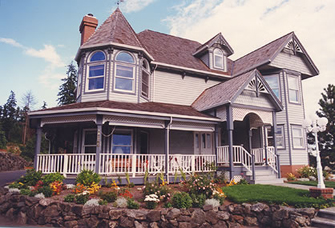
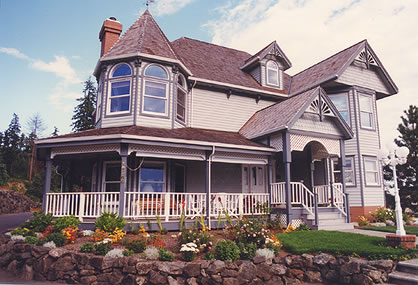
Our inventory of Victorian house plans is small, but it continues to grow. Like all of our plans, our Victorian home plans are quite detailed, and contain a great deal of information. The Victorian floor plans you’ll find on our site combine modern interior design with the turn-of-the-century exterior design details that so many people love.
Common Characteristics of Victorian House Plans:
- Steeply pitched roof of irregular shape
- Usually has a dominant front-facing gable
- Shingles laid in a decorative pattern
- Often have cutaway bay windows, and other devices used to avoid a smooth-walled appearance
- Asymmetrical façade with partial or full-width porch which may extend along one or both side walls
Click on the button below to browse our Victorian Home plans!
What follows are excerpts from “American House Styles: A Concise Guide”, written by John Milnes Baker, A.I.A., and published by W. W. Norton in 1994
Queen Anne (Victorian) 1880-1910
The Queen Anne style is almost the quintessential style of Norman Rockwell’s America. Popular in
its heyday, it has recently been rediscovered and is often celebrated with wild “boutique” colors.
The style evolved in England as an outgrowth of the Arts and Crafts movement of the mid-nineteenth
century. The British government built two half-timbered buildings at the Philadelphia Centennial Exposition
in 1876. These structures were the impetus for the Queen Anne style in this country.
Henry Hobson Richardson’s William Watts Sherman house built in Newport, Rhode Island, in 1874 is usually considered the first Queen Anne house by an American architect. It featured quasi-medieval half-timbering, assertive chimneys, and a varied but cohesive surface pattern – all deftly handled by one of our great architects. The style quickly became popular here but was not favored by architects. They generally preferred the Shingled style which evolved from some of the same sources but used a more cogent vocabulary. The Queen Anne style was promoted in publications like the American Architect and Building News, our first architectural magazine, and was sold precut by mail-order companies. Components like knee braces, brackets, and spindles were also shipped across the country to embellish older vernacular houses.
The American Queen Anne differed from the English in its exuberant use of scroll work and applied detail. The English built brick houses and Americans wood. The Carson House in California, begun in 1884, is the ultimate example of the style. Floor plans were usually open and free-flowing. Double parlor doors were popular as were corner fireplaces. America’s love affair with the porch or verandah found fulfillment in the Queen Anne style. Turrets, towers, and fanciful gazebos characterized the style along with varied shingle patterns and wall surfaces. One cannot call it the Victorian style - it is simply one of many.
The term Eastlake is sometimes confused with Queen Anne. In the 1870s and1880s decorative components were mass produced by mechanical lathes and jigsaws and were used to embellish eclectic houses with fancy scrollwork, turned balusters and porch posts, beaded spindles, and sometimes even wrought-iron embellishments. The English interior designer Charles Locke Eastlake (1833-1906) disassociated himself from the style that bears his name.